
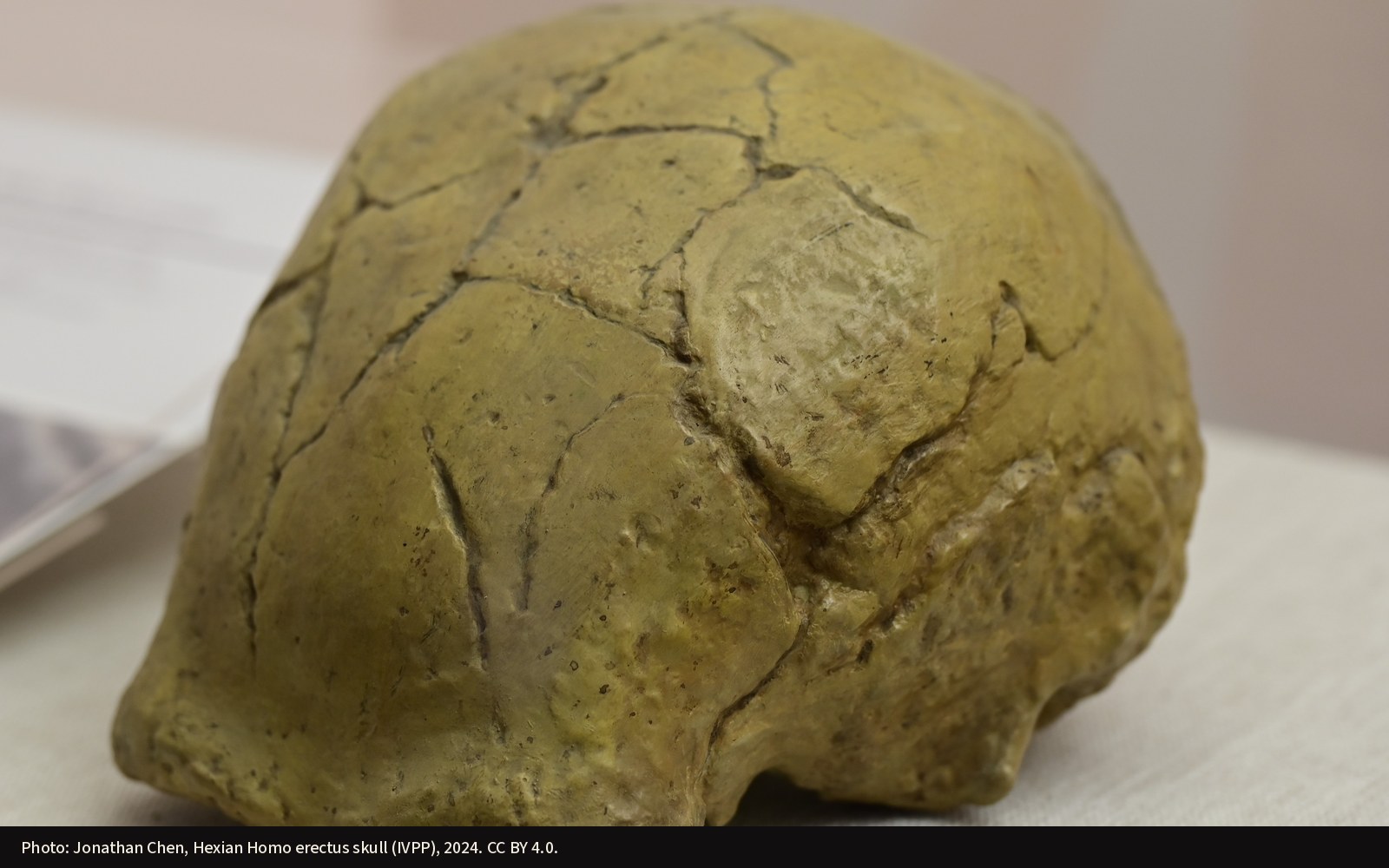
The ancient human species Homo erectus survived on the Asian mainland about 200,000 years longer than scientists had thought, and lived in dense tropical rainforest, according to two studies published in the journal Nature, Scientific American and the University of Copenhagen reported.
Researchers analyzed nine fossil teeth found in Naxian Cave and Baxian Cave in the Guangxi region of southern China, eight of which were identified as Homo erectus, the University of Copenhagen said. A team co-led by Kira Westaway, a geochronologist at Macquarie University in Australia, dated the fossil-bearing layers with five independent methods, placing the fossils between 324,000 and 184,000 years ago, Scientific American reported. Before these finds, no securely dated Homo erectus fossils younger than about 400,000 years had been found on the Asian mainland, the magazine said.
Carbon isotopes in animal teeth at the sites showed the animals fed only in closed-canopy forest, and the Homo erectus teeth carried similar signatures, suggesting the hominins lived in the rainforest rather than passing through, Scientific American reported. Strontium signatures that did not match the local limestone suggested the individuals traveled widely, possibly from as far as northern Vietnam, about 250 kilometers away, the magazine said.
In the second study, a team led by Frido Welker of the University of Copenhagen analyzed proteins preserved in tooth enamel. DNA rarely survives more than a few thousand years in warm, humid environments, but proteins last longer, the university said. “Just ten years ago, nobody would have believed it possible to recover such detailed protein information from fossils this old,” Welker said.
The findings challenge the view that Homo erectus was a specialist suited to grasslands and woodlands, Scientific American reported. “This emphasizes that behavioral flexibility was likely a key to Homo erectus success,” said Susan Antón, a New York University paleoanthropologist who was not involved in the research.
One tooth from Baxian Cave did not match Homo erectus, Neanderthals or modern humans, the researchers said. “I think Denisovans would be the first option to consider,” Welker told Scientific American, while cautioning that no comparable Denisovan tooth exists for comparison. If confirmed, it would mean at least two human species lived in the region at the same time, the University of Copenhagen said.
Westaway told Scientific American her team returns to China every year, with cavers exploring four or five caves a day.