
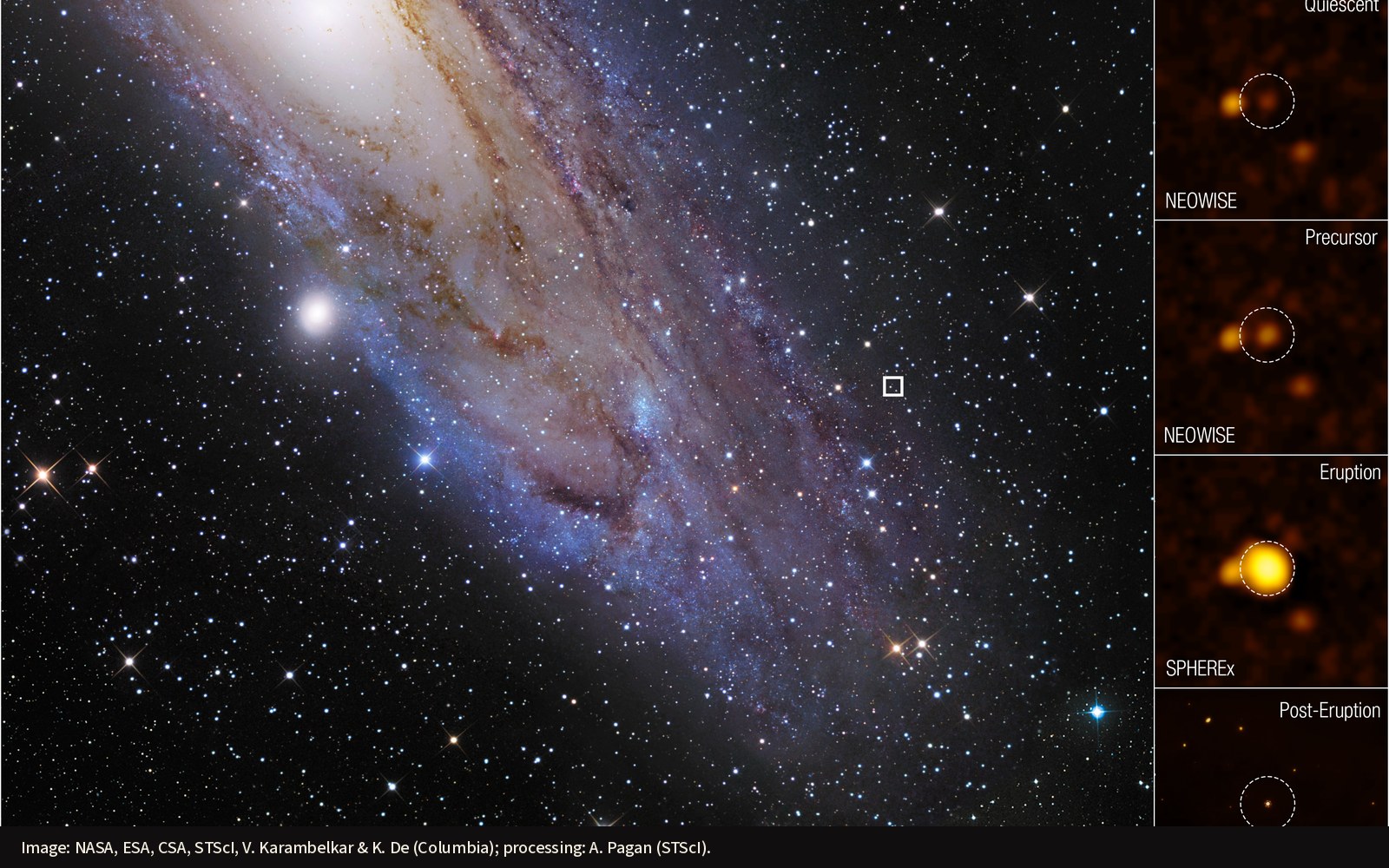
Observations from NASA’s James Webb Space Telescope provided the final evidence that allowed researchers to reconstruct a stellar merger in the Andromeda galaxy NASA said Wednesday. The system, formally known as AT 2025abao and nicknamed Bao, is about 2.5 million light-years from Earth. A paper describing the work by Viraj Karambelkar, a NASA Hubble Fellow at Columbia University, and colleagues was published Wednesday in Nature.
Researchers identified a star slightly less massive than the Sun that spiraled into and merged with a puffy supergiant at the outskirts of Andromeda, NASA said. “Stellar mergers are very, very difficult to observe in real time because they are hard to predict,” Karambelkar said in the NASA release. The team noticed unusual activity in 2023, kept watching, and saw the system erupt in 2025. Webb observed Bao 47 days after the eruption peaked, “the earliest ever follow-up of an event like this,” he said.
Before the merger, the primary star was about seven times as massive as the Sun, 350 times the Sun’s radius and 18,000 times as bright, according to the team’s modeling, NASA said. The smaller companion, “Little Bao,” was estimated at about 0.7 times the mass of the Sun. Once the smaller star came into contact with the giant’s surface, the unification happened after only seven orbits, about seven years, much faster than other known mergers of two smaller stars, NASA said. “We thought an outburst from a such an extended star would take years,” co-author Nadia Blagorodnova of the University of Barcelona said in the release. “One day, its brightness started rising and within a week, it peaked!”
The process is known as common envelope evolution, in which two stars share an outer layer of gas. In this case, the primary engulfed the smaller star, which spiraled inward as drag robbed it of orbital energy, NASA said. Webb’s mid-infrared observations, taken on Dec. 24, 2025, detailed dust shed by the more massive star and, matched to simulations, showed that the stars merged. Co-author Kishalay De of Columbia University described the encounter as “almost like a bomb exploding inside a living star.”
The team first noticed Bao in February 2023 in data from NASA’s retired NEOWISE mission, and later observations came from several other telescopes, NASA said. The Zwicky Transient Facility detected the eruption on Oct. 17, 2025. Karambelkar said NASA’s recently launched Nancy Grace Roman Space Telescope is expected to yield a large number of similar transients. Astronomers usually have to reconstruct mergers long after they happen. This time, they watched one unfold, and the next few years may bring many more chances to do the same.