
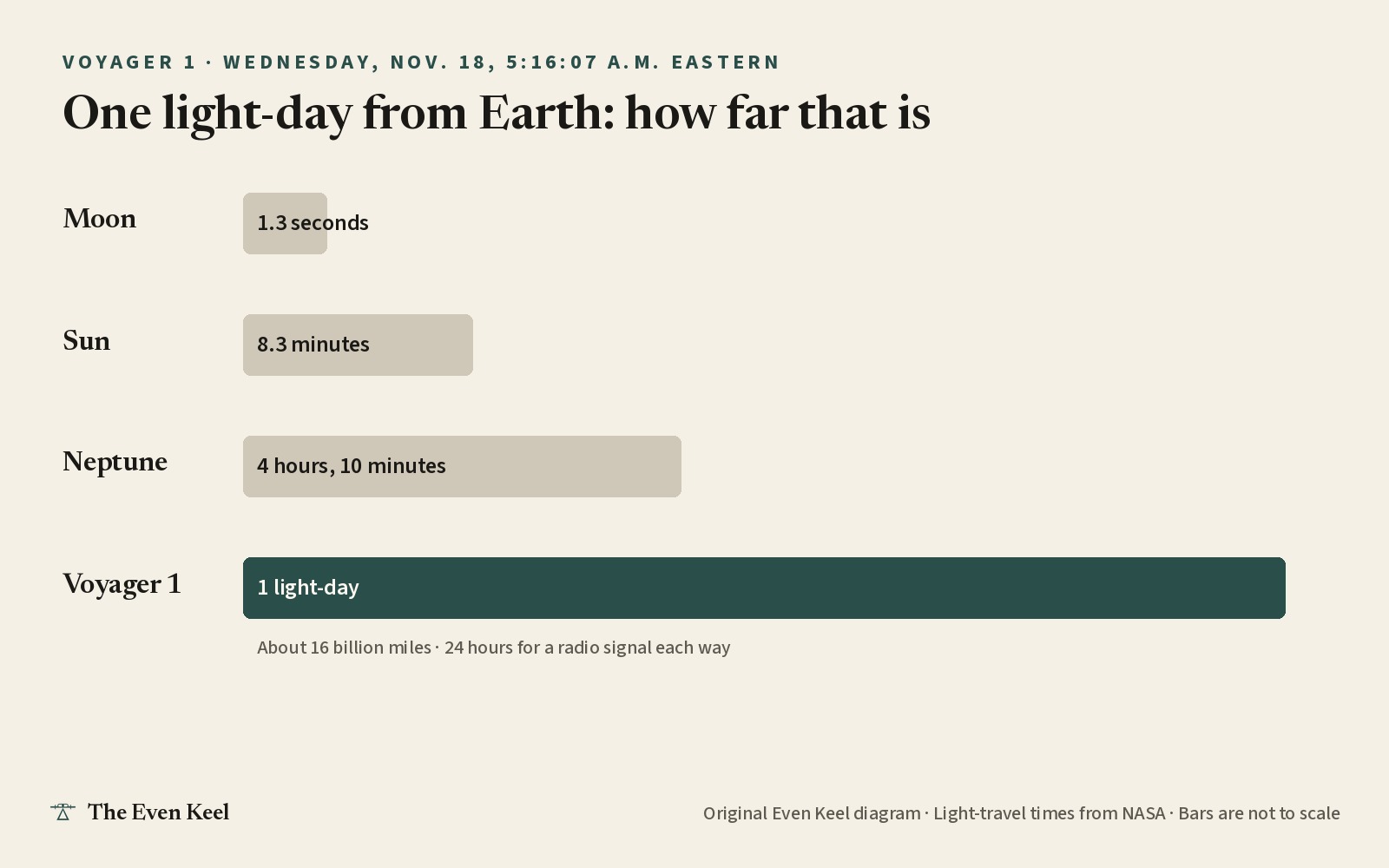
NASA’s Voyager 1 spacecraft will reach one light-day from Earth on Wednesday, Nov. 18, at 5:16:07 a.m. Eastern, a distance no other human-made object has traveled, the space agency said. A light-day is the distance light — or a radio signal — can travel in 24 hours, about 16,094,799,096 miles, or 25,902,068,356 kilometers, NASA said. Space.com, in an account published as the milestone approached, also reported the Wednesday mark and the same clock time.
At that distance, a message from Earth will take a full day to arrive, and Voyager’s reply will take another day to return, NASA and Space.com reported. NASA said the spacecraft will have taken 49 years, two months and 11 days to cover a distance light crosses in a day, calling it “a huge milestone by any measure, and a day worth celebrating.” Voyager 1 remains the most distant human-made object, NASA’s Jet Propulsion Laboratory said in a Nov. 17 advisory.
The probe launched from Kennedy Space Center in Florida on Sept. 5, 1977, two weeks after its twin, Voyager 2, NASA and Space.com reported. Voyager 1 entered interstellar space in August 2012; JPL said Voyager 2, which took a different path in order to visit Uranus and Neptune, entered interstellar space in 2018. Both spacecraft are still returning scientific data, JPL said. Voyager 2 is on pace to reach one light-day from Earth in November 2035, NASA said. Space.com put Voyager 2’s present distance at 13.5 billion miles, or 21.7 billion kilometers.
Voyager 1 is traveling at nearly 38,000 mph, or about 61,000 kph, and is headed in the direction of the star AC +79 3888, also known as Gliese 445, more than 17 light-years away, NASA said. The spacecraft is expected to pass within about 1.7 light-years of that star in 40,000 years, NASA and Space.com reported.
NASA invited the public to mark the approach on Tuesday after sunset in a “Shine Bright for Voyager’s Light-Day” event, creating a symbolic wave of golden light, the agency and JPL said. JPL will host a discussion with mission leaders on Thursday at noon Eastern.
It took nearly half a century to travel a distance light crosses in a single day. After Wednesday, a greeting from Earth will need 24 hours to reach the spacecraft — and another 24 hours before anyone here can hear back.