
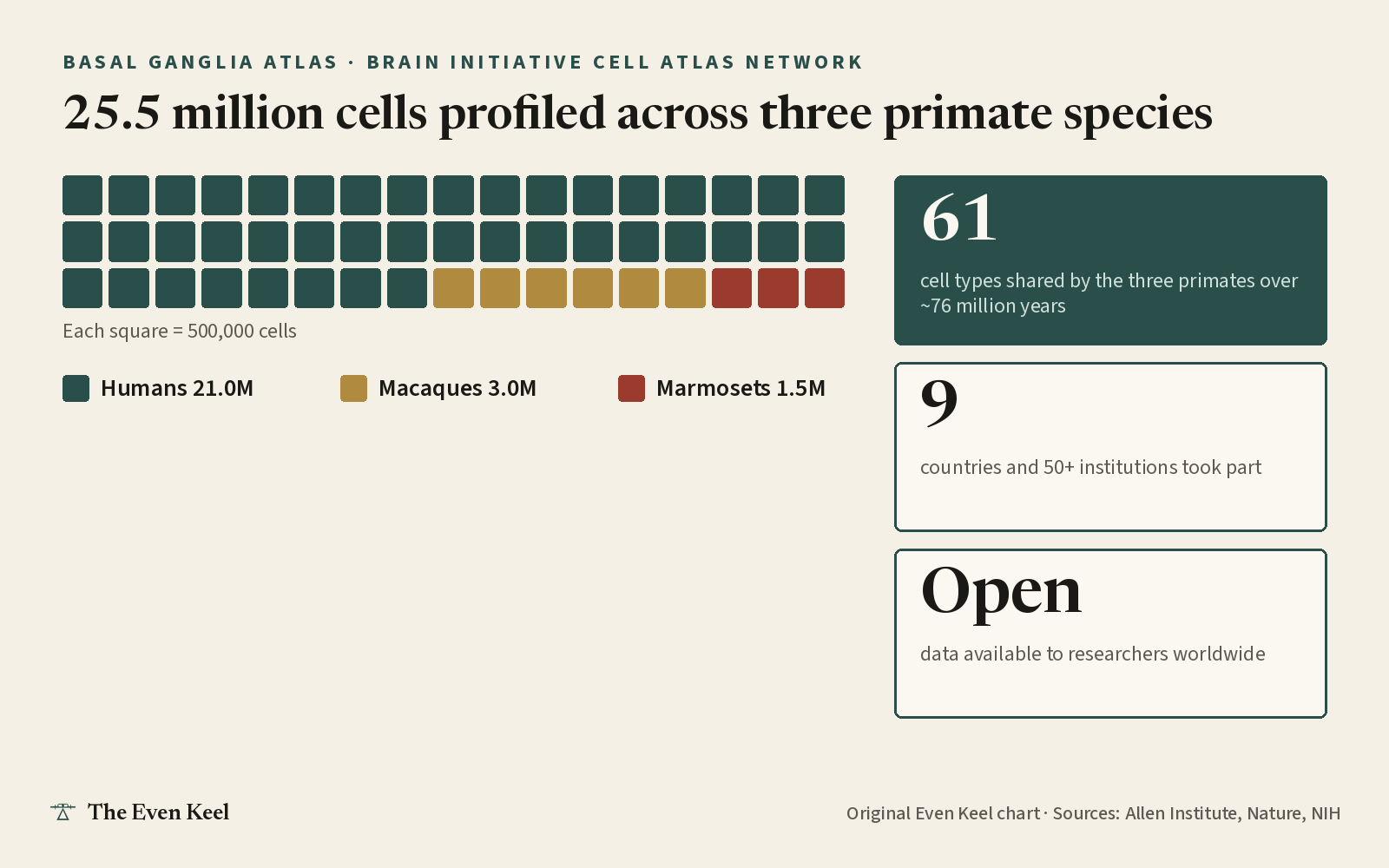
An international team has published the most detailed map yet of the basal ganglia, a set of structures deep in the brain linked to Parkinson’s disease, Huntington’s disease, schizophrenia, bipolar disorder and addiction, Nature reported. The researchers profiled 25.5 million cells: 21.0 million from humans, 3.0 million from macaques and 1.5 million from marmosets, the Allen Institute said.
The work, released Thursday in more than two dozen papers across Cell Press journals, is the first major output of the BRAIN Initiative Cell Atlas Network, a $500 million National Institutes of Health project launched in 2022 to map mammalian brains, according to Nature. Hundreds of scientists at more than 50 institutions in nine countries took part, and the data are openly available, the Allen Institute said. NIH described the basal ganglia as critical for “turning thoughts into actions.”
Comparing the three primate species, researchers identified 61 cell types conserved over 76 million years, Nature reported. Allen Institute researchers described a previously unreported neuron type, called STR D2 SMYD2-HTR7, that carries elevated genetic risk for schizophrenia. “This atlas narrows the genetic disease signal down to a specific population that researchers can now explore,” study author Nelson Johansen said.
A Broad Institute-led study of the striatum, the basal ganglia’s largest structure, found six molecular zones that look identical under a microscope but differ sharply in gene activity, Nature reported. The differences between zones faded with age, especially in areas affected by Huntington’s and Parkinson’s. Other papers in the package reported possible striatum cell disruptions in autism and an enhancer-guided gene therapy that eased Parkinson’s-like symptoms in mice with fewer side effects, NIH said. Those results come from tissue studies and animal models, not human trials.
Another study of nearly 4 million cells from 178 deceased donors found that the cellular makeup of the striatum and prefrontal cortex varied from person to person, which Nature said underscores the need for atlases to account for individual differences. “It’s a massive dictionary that we needed in the field,” Ana Muñoz-Manchado, a University of Cádiz neuroscientist, told Nature.
Broad Institute researchers also found that a person’s age could be predicted from gene activity across several brain cell types, the Allen Institute said — a possible foundation for brain-based biological aging clocks.